01 / OrganizationThe company is a logistics SaaS platform with a bigger ambition
The company is positioned in information technology and supply-chain SaaS, serving shippers and logistics service providers across multiple industries.
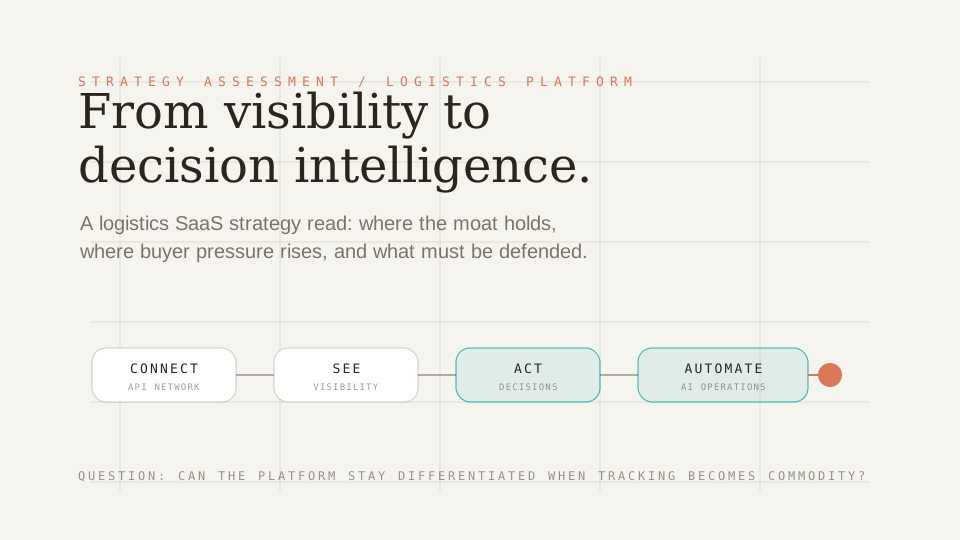
The deck frames it as a next-generation logistics and decision intelligence company: a one-stop platform with multimodal coverage, enterprise customers, ARR growth, major funding, and a valuation around the scale of a category leader.
Its stated mission combines access, cost reduction, and sustainability: democratizing logistics intelligence, lowering supply-chain costs, and reducing waste and excess inventory in global operations.
02 / Where To PlayThe platform has expanded across the logistics value chain
The strategy is not limited to midstream shipment visibility. The assessment maps the platform across upstream planning and sourcing, midstream execution and transit, downstream facilities and delivery, and an underlying data and infrastructure layer.
The platform acts as connective tissue between fragmented parties: shippers, carriers, logistics service providers, telematics systems, and enterprise tools that historically struggled to communicate efficiently.
This expansion is the basis for the strategic claim: the platform is trying to enter a blue ocean by becoming a decision layer for supply-chain orchestration, not just a visibility vendor.
03 / How To WinAPI connectivity and data quality are the centre of the moat
The assessment contrasts legacy EDI with modern API connectivity. EDI is slower, batched, and asynchronous; APIs enable faster, real-time data exchange that can support immediate decision intelligence.
The deck argues that competitors may look similar at the interface level, but the underlying difference is connection quality, data volume, and reliability.
Strategic advantages include more than 4.6 million unique shipments per day, historical shipment data for AI models, access to difficult data sources such as China-related visibility, and a carrier-centric approach that improves data quality through voluntary participation.
04 / Internal ConfigurationThe organization is built around platform, data, and enterprise adoption
Internally, the company is read as a platform-based, functionally organized SaaS business with platform core, engineering, product, data science, network layer, go-to-market, delivery and retention, and corporate functions.
The value chain starts with inbound data from carrier and telematics integrations, moves through normalization and AI-driven alerts, and becomes dashboards, system integrations, enterprise selling, implementation, and customer success.
Management capabilities include radical transparency through KPI tracking, AI adoption mandates, cross-department collaboration, and talent density focused on difficult operational problems.
05 / VRIOThe strongest advantages are networked and cumulative
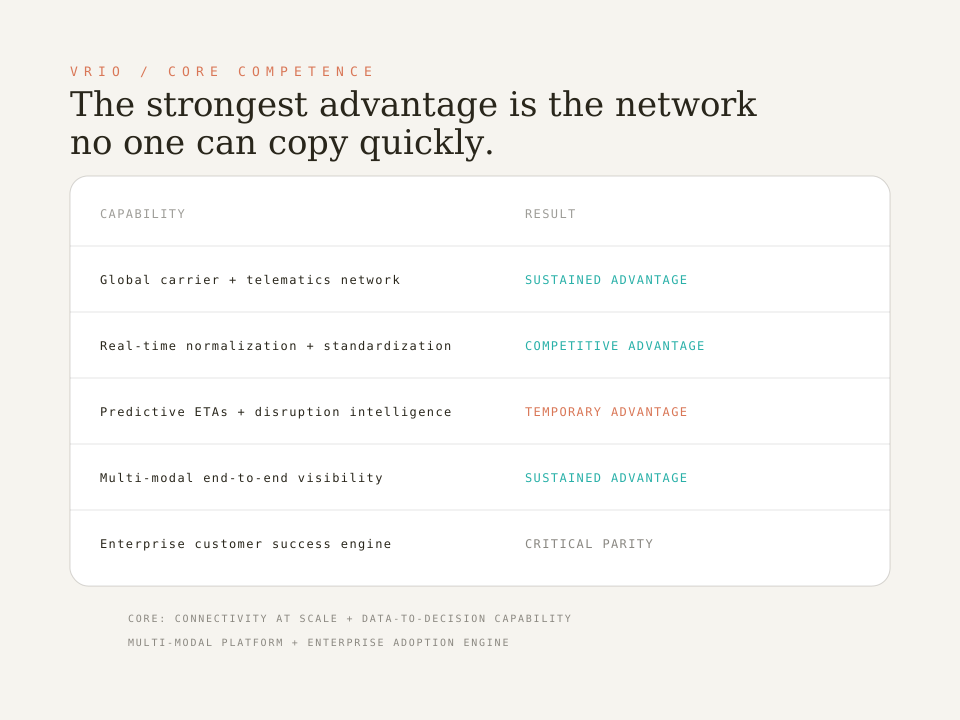
The VRIO analysis marks the global carrier and telematics network, multimodal end-to-end visibility, and brand trust with large global shippers as sustained competitive advantages.
Real-time data normalization and standardization create competitive advantage, while predictive ETAs and disruption intelligence are treated as more temporary because rivals can imitate the capability over time.
The core competencies are connectivity at scale, data-to-decision capability, a multimodal platform, and an enterprise adoption engine that helps complex customers reach time-to-value.
06 / External PressureThe market pressure is high because the category is converging
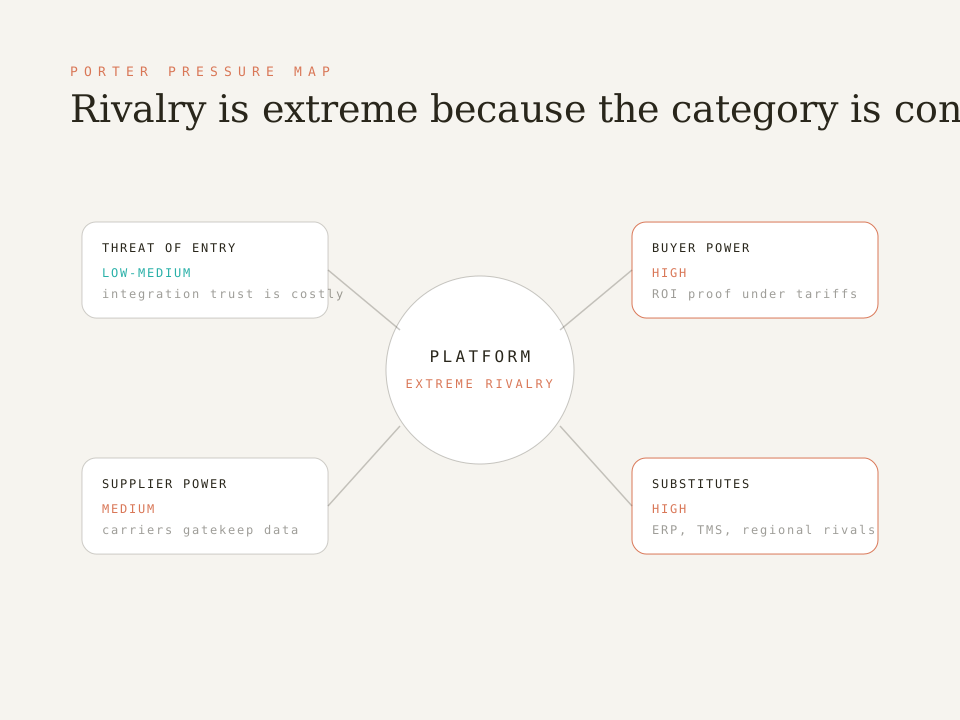
Porter analysis shows low-to-medium threat of entry because integrations, trust, and data security are difficult, but supplier power is medium because carriers and brokers can gatekeep or monetize data access.
Buyer power is high because tariffs, uncertainty, and rising costs push enterprises to demand fast proof of ROI and additional analytics, such as landed-cost intelligence.
Substitute pressure is high: FourKites, Shippeo, SAP, Oracle, ERP-native tools, TMS platforms, and LOGINK-style alternatives can make visibility feel more replaceable. The deck characterizes overall rivalry as extreme.
07 / Current StrategyThe current strategy narrows the business to defend quality
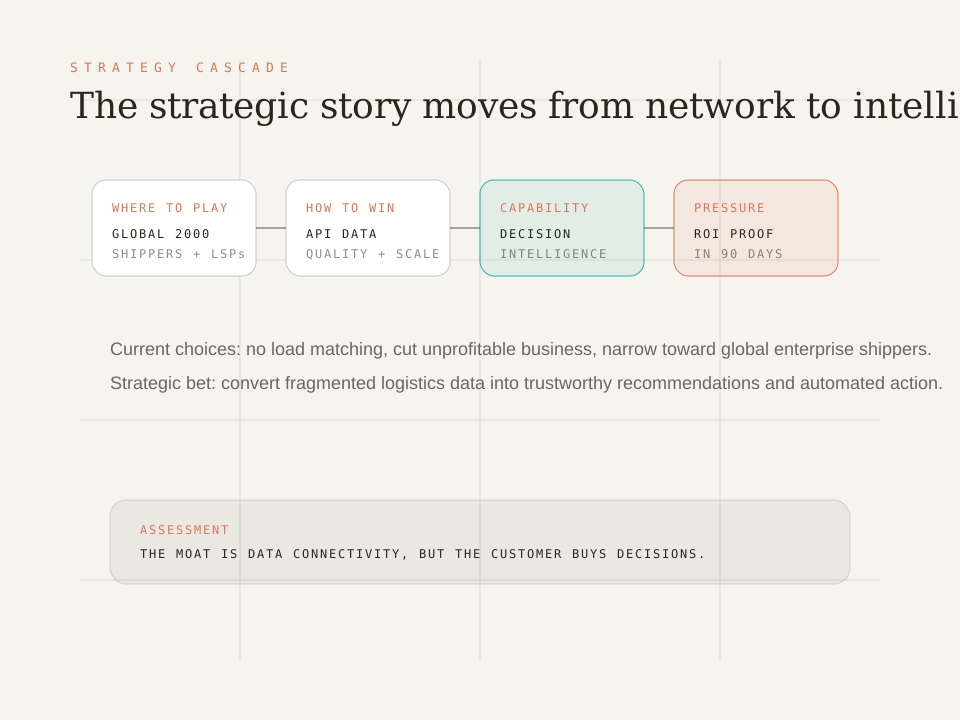
The assessment notes several strategic choices: the company chose not to provide a load-matching platform, cut $30M of unprofitable business to reach breakeven, and narrowed toward global 2,000 shippers.
These choices point to focus: avoid commoditized matching, remove weak revenue, and concentrate on enterprise customers who value global scale, reliability, and decision intelligence.
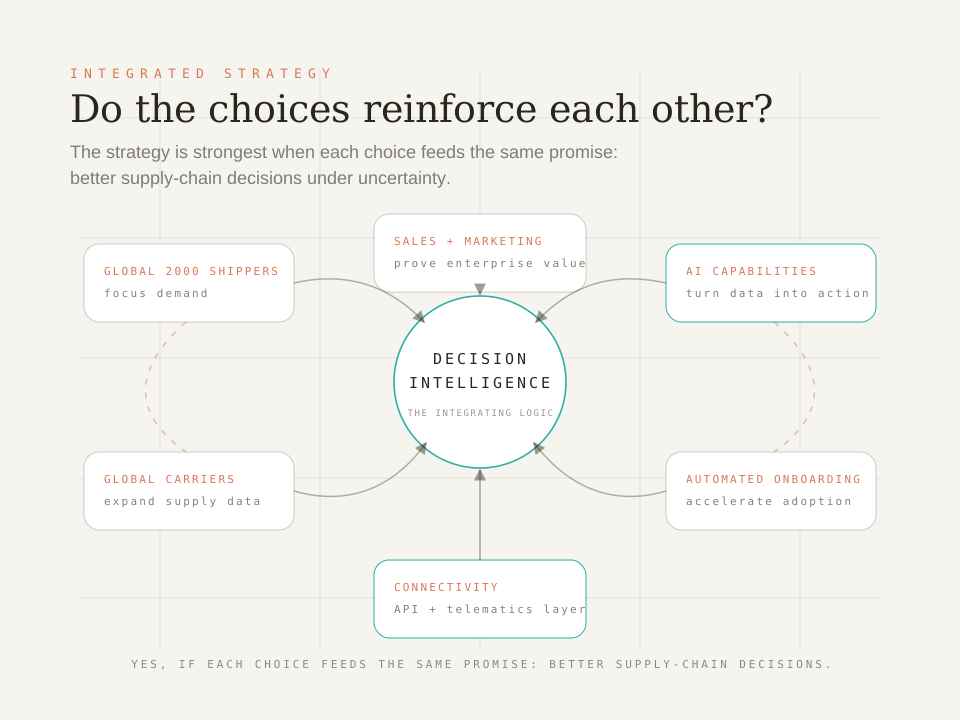
The logic is integrated when global clients, global carriers, connectivity, AI capabilities, automated onboarding, sales and marketing, and platform data ingestion reinforce one another.
08 / IntegrationThe choices are integrated when they all serve decision value
The strategy diagram asks whether the choices reinforce one another rather than sit as separate initiatives.
Global 2,000 shippers focus demand. Global carriers and connectivity expand the supply of operational data. Platform ingestion and AI capabilities translate that data into intelligence. Automated onboarding and sales make the system adoptable.
The answer is conditional: the strategy is integrated if every choice strengthens the same promise, helping customers make better supply-chain decisions under uncertainty.
09 / Strategic TensionsThe weak points are integration cost, data quality, and perceived commodity value
The deck names the first tension as the continuous cost of integrating with carrier systems, including apps, EDI, telematics, and APIs that require ongoing health checks.
The second tension is end-to-end coverage across carrier types. More coverage creates more data-quality risk, which makes enterprise-grade AI automation harder to deliver reliably.
The third tension is price pressure: many enterprises still see visibility as tracking, and alternatives make the offer look commoditized unless the platform proves decision value clearly.
10 / Burning PlatformsAI positioning and trade policy pressure make the strategy urgent
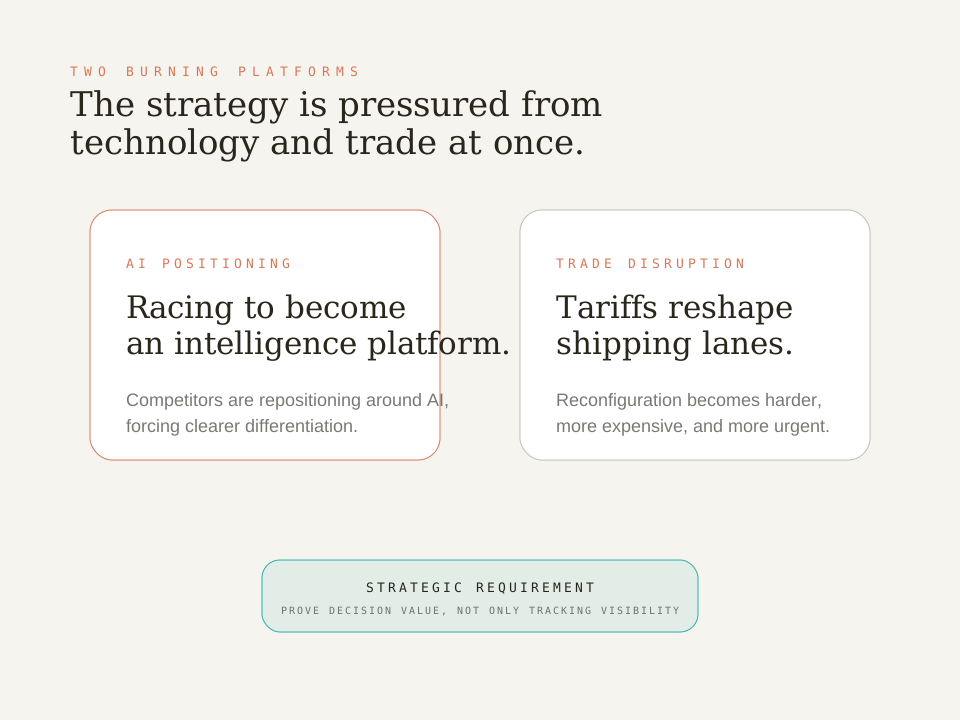
One burning platform is the AI arms race. Competitors are positioning themselves as intelligence platforms, increasing pressure on the company to prove differentiation beyond visibility.
The second burning platform is trade volatility. Trade wars, tariffs, and changing shipping lanes make supply-chain reconfiguration harder, more expensive, and more important for customers.
Together, these pressures make the strategic requirement clear: the platform must turn data connectivity into trusted, explainable, customer-relevant decisions faster than the category turns visibility into a commodity.
11 / SynthesisThe strongest next move is synthesis, not more analysis
The strongest opening is the company snapshot: what the platform offers, how it makes money, and why the company matters.
The value-chain and core-competency work is useful, but the case becomes stronger when those tools lead to one or two sharp strategic insights.
The most important question is strategic: what can the platform do that competitors cannot easily copy, and how can that advantage be protected as logistics visibility becomes a more crowded category?