01 / Strategic ContextRare earths sit inside the infrastructure of modern security
Rare earth elements support permanent magnets, wind turbines, electric vehicles, energy-efficient motors, electronics, aerospace systems, defence technologies, and other advanced systems.
Canada has significant resources, including major deposits, but its position is not automatically secure because processing, separation, refining, and downstream manufacturing capacity remain difficult to build.
The project reframes rare earths as part of national resilience: the question is not only who has minerals, but who can govern the complete system that turns them into strategic capacity.
02 / Central QuestionThe question connects supply chains to national security
The guiding question asks how Canada’s critical mineral supply chain might impact national security by 2046.
That framing matters because mineral systems are no longer purely economic. They intersect with geopolitical competition, technological capacity, energy transition, defence readiness, and alliance strategy.
The work gives policy leaders a way to examine how today’s investment, partnership, regulatory, and infrastructure decisions could shape Canada’s future position.
03 / Horizon2046 is long enough for structure to change
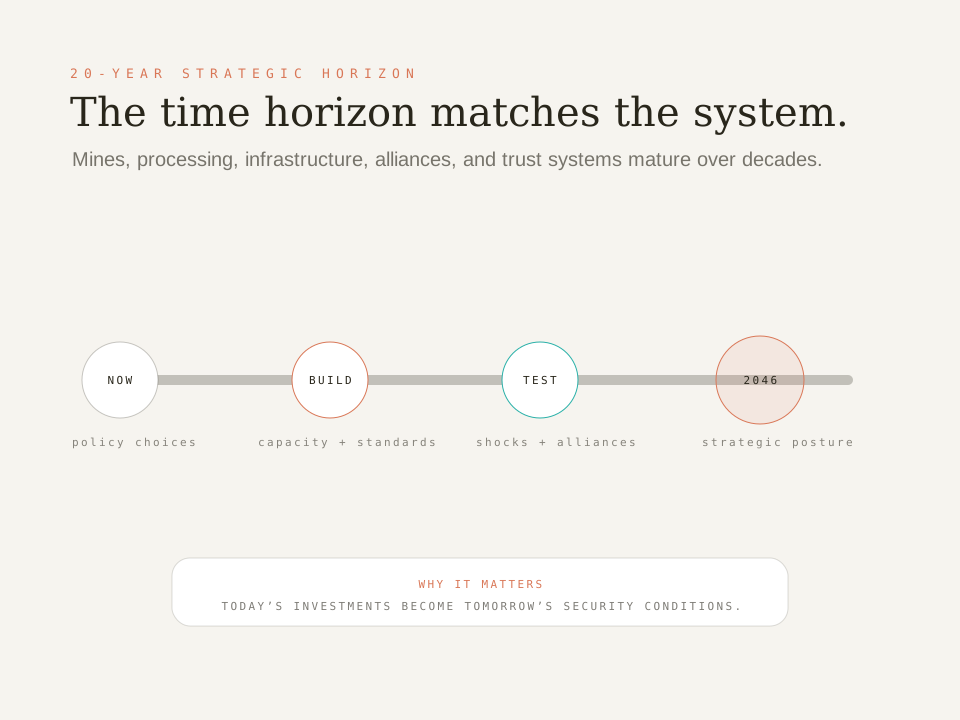
A 20-year horizon matches the time scale of mineral development. Mines, processing facilities, infrastructure networks, regulatory systems, and international partnerships often take decades to mature.
The horizon is also close enough to remain relevant for current policy decisions. It lets present-day leaders see how today’s choices could become future security conditions.
This is why the work focuses less on prediction and more on strategic preparedness: what must Canada be able to handle if the system evolves in sharply different directions?
04 / MethodThe method turns uncertainty into a structured possibility space
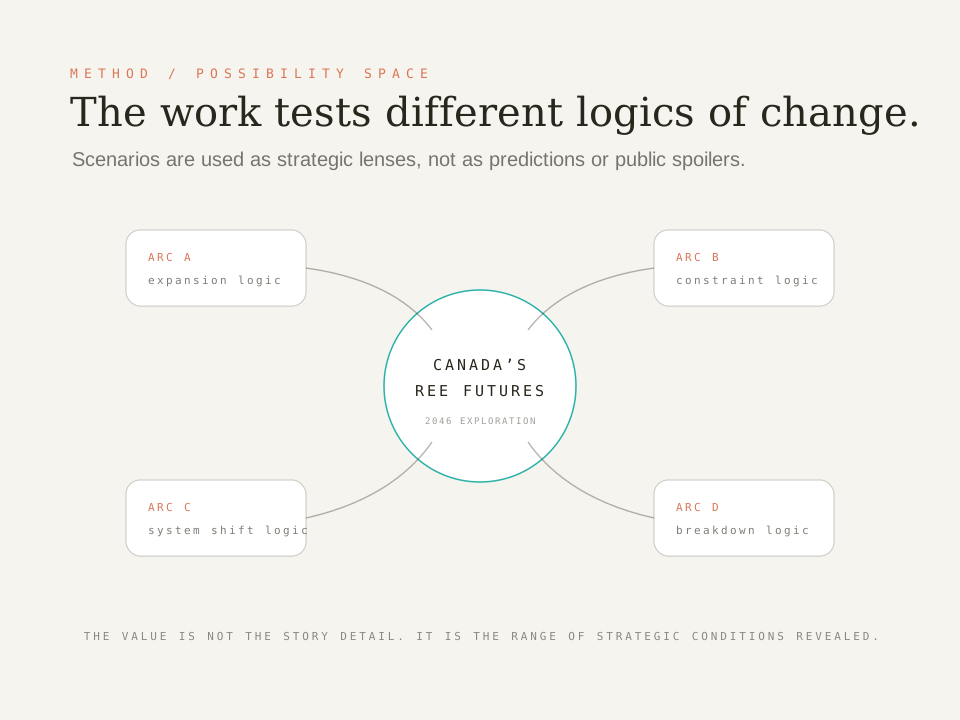
The report uses a structured foresight approach based on archetypal images of the future. This helps avoid treating the future as a single forecast.
The scenarios are presented as concise future pictures. Each one makes a different logic of change visible, so leaders can compare what different futures would demand.
The method creates a possibility space where policy choices can be stress-tested against different logics of change: expansion, constraint, transformation, and breakdown.
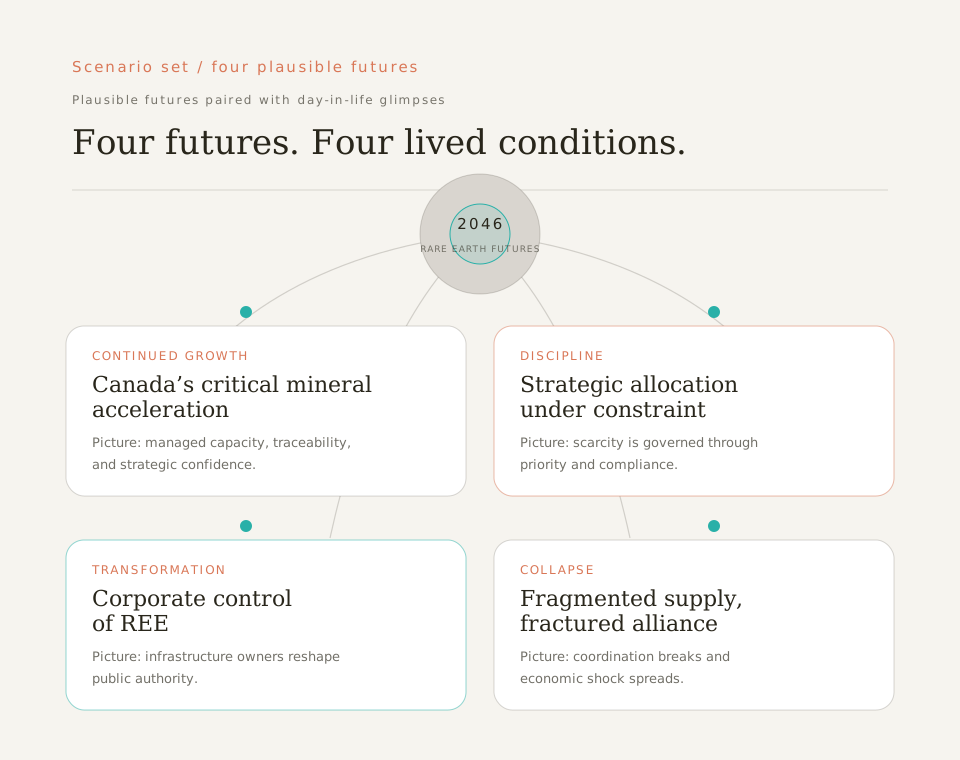
05 / Scenario SetFour plausible futures show the strategic range Canada may need to handle
Continued Growth / Canada’s Critical Mineral Acceleration: Canada turns resources, processing, recycling, verification, and allied coordination into a more mature mineral system. The high-level picture is not endless extraction; it is managed capacity, traceability, and strategic confidence.
Discipline / Strategic Allocation Under REE Constraint: Canada remains resource-rich but not surplus-rich. Scarcity becomes governable through allocation rules, compliance systems, repair cultures, and difficult choices about what gets priority.
Transformation / Corporate Control of REE: power shifts toward corporations and infrastructure owners. The high-level picture is altered sovereignty, where control of mineral systems, data systems, and protected zones begins to reshape public authority.
Collapse / Fragmented Supply Chain, Fractured Alliance: trusted coordination breaks down and Canada has to respond to economic shock, delayed projects, investor hesitation, and strained alliances. The future is not total failure, but a system losing the stability it expected.
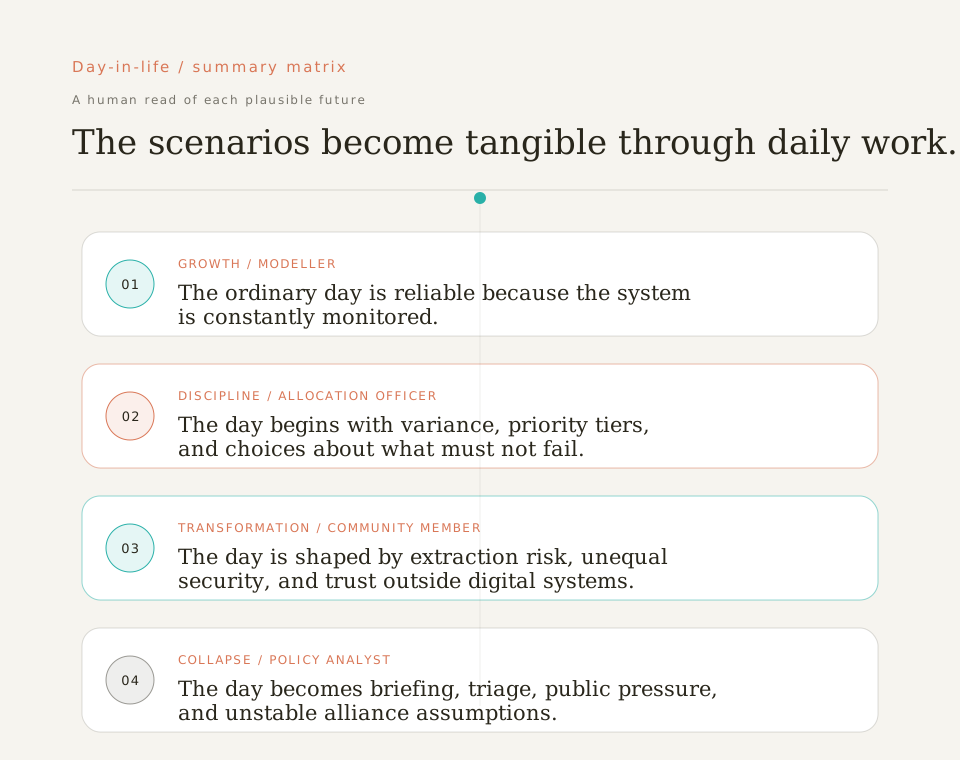
06 / Human LensEach scenario becomes clearer when translated into a day in a life
Growth, day-in-life: a national mineral systems modeller works inside a stable but constantly monitored system. Her ordinary day is shaped by dashboards, provenance data, digital twins, and the quiet work of keeping critical flows within safe margins.
Discipline, day-in-life: an allocation officer starts the day with a supply variance and has to protect essential sectors first. The work feels less like market management and more like deciding which needs must be protected when material is limited.
Transformation, day-in-life: a young person living near an altered extraction zone experiences the future as environmental risk, corporate power, and information distrust. The human question becomes who gets security, who loses agency, and what forms of trust survive.
Collapse, day-in-life: a policy analyst prepares urgent briefings as alliance assumptions weaken and economic expectations unravel. The day is defined by uncertainty, public pressure, and the need to make choices before stability returns.
07 / Policy UseThe work supports better long-term questions
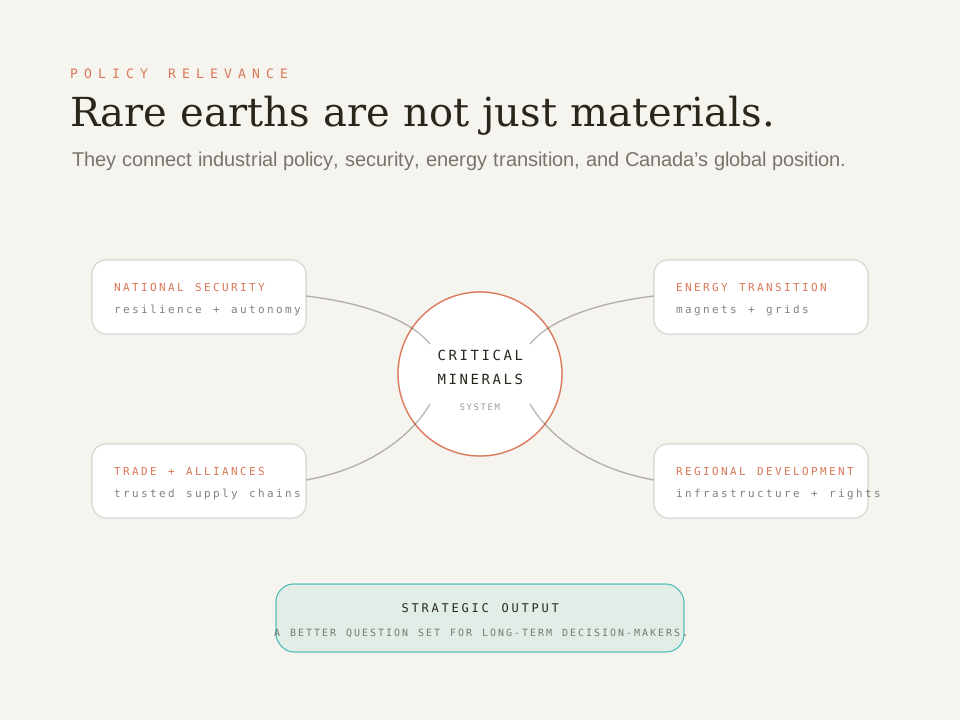
The intended audiences include federal policy communities working on national security, natural resources, economic resilience, energy transition, trade, defence procurement, and regional development.
The output helps leaders ask sharper questions: where is Canada structurally exposed, which dependencies matter most, what capacities must be built domestically or with allies, and what forms of governance would make the system resilient?
The most useful foresight output is not certainty. It is a better decision frame for present choices that may only reveal their consequences years later.
08 / What It ProvesForesight can make strategic dependency visible before it becomes crisis
The project shows how foresight can translate a technical supply-chain issue into a broader strategic conversation about sovereignty, security, resilience, and responsibility.
It demonstrates that rare earth security depends on more than extraction. It depends on processing capacity, trusted standards, infrastructure, alliance design, information integrity, and governance readiness.
The case preserves the central value of foresight: leaders can use alternative futures to locate today’s blind spots before they harden into tomorrow’s constraints.