01 / QuestionWhat does AI infrastructure take from water systems?
The research looks at how AI data centres use water across cooling, electricity, and hardware manufacturing. The concern is simple: AI infrastructure is growing quickly, while its water footprint is still measured unevenly and regulated weakly.
The proposed response is a public reporting standard for AI data-centre water use. It would use shared metrics, third-party checks, incentives, and penalties so disclosure becomes comparable instead of selective.
This is not only an environmental issue. It is a planning issue. Without clearer measurement, communities and policymakers cannot see where new infrastructure may put pressure on already stressed water systems.
02 / EvidenceAI is using more water, but the numbers are hard to trust
The literature shows three main channels of water use: direct cooling inside facilities, water used to generate electricity, and water embedded in chips and hardware production.
The public numbers do not yet tell a consistent story. Some claims describe tiny per-query use, others describe much higher per-prompt estimates, and many companies report total operational water without showing model-level or lifecycle detail.
That inconsistency matters. A facility can look efficient in one metric while shifting pressure somewhere else. Water, energy, carbon, cooling technology, and local geography need to be read together.
03 / GapThe scale is already large enough to matter
The report notes that U.S. data centres consumed about 163.7 billion gallons of water in 2021, with demand projected to rise by up to 170% by 2030 as AI workloads and cooling capacity grow.
At the model level, the research cites an estimate that training GPT-3 required about 5.4 million litres of water. At the infrastructure level, U.S. AI systems could consume 731-1,125 million cubic meters of water annually by 2030.
The point is not that every number is final. The point is that the range is already consequential, while the public measurement system is still too fragmented to guide decisions confidently.
04 / Strategic TensionSaving water in one place can create pressure somewhere else
The research highlights a water-energy tradeoff in data-centre cooling. Wet cooling can be energy efficient but water intensive; dry or air cooling can reduce water use while increasing electricity demand.
A narrow water policy can accidentally increase energy use, while a narrow carbon policy can hide water stress. The system needs to be evaluated across water, energy, carbon, cooling technology, and local conditions.
That is the real strategic tension: the right answer depends on where the facility is, how electricity is generated, what water source is used, and who bears the local consequences.
05 / GapCurrent disclosure shows the facility, not the whole system
The research identifies four gaps: no shared governance framework, limited lifecycle accounting, weak framing of water as a strategic infrastructure issue, and too little connection between disclosure and enforceable decisions.
Most data-centre reporting focuses on direct on-site water. Electricity-related water and supply-chain water are rarely published, even though they shape the real footprint.
Voluntary sustainability frameworks help, but adoption is uneven. The case argues for AI-specific standards with regulatory force, comparable metrics, and independent verification.
06 / MethodThe method turns a vague concern into evidence leaders can use
The design begins with a survey to map where AI data centres are now, where growth may happen over one to three, five, and ten years, and what factors shape siting decisions.
Workshops then ask companies and infrastructure actors how they currently track water impacts, where reporting breaks down, and what practical templates could be co-designed.
Interviews with regulators, policymakers, environmental authorities, NGOs, and compliance experts test what could realistically be enforced: incentives, penalties, audits, legal barriers, and implementation steps.
07 / PeopleThe people affected by water stress may not control the data
Hyperscalers, colocation operators, utilities, planners, and AI technicians hold the operational knowledge: where facilities are built, how they are cooled, and where expansion may go next.
Sustainability, operations, compliance, and reporting teams know what is currently measured and where lifecycle data becomes difficult to access or compare.
Communities, Indigenous and marginalized groups, regulators, NGOs, and environmental authorities carry the accountability question: who gets to know, who gets protected, and what happens when water risk is hidden?
08 / OutputThe goal is not another report. It is reporting that can be enforced.
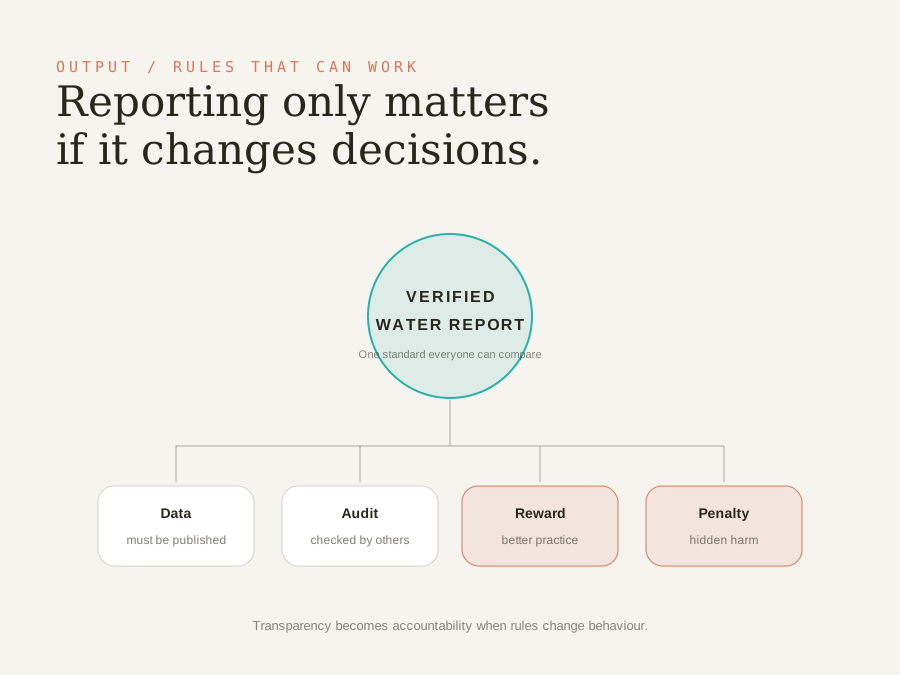
The proposal imagines a practical framework with standard metrics, third-party audits, disclosure requirements, incentives for better performance, and penalties for harmful or opaque behaviour.
It also plans for resistance. If regulation is rejected, the work can move through international coalitions. If companies refuse to participate, the framework needs independent estimation methods. If legal backlash appears, the design needs legal strategy built in.
At its core, this is strategic design: make a hidden system legible, bring the right actors into the room, and create conditions where infrastructure decisions can be judged before harm becomes obvious.
09 / What It Could BecomeA verified standard could turn disclosure into a market signal
The report points toward a future certification model, described as something like “Blue-AI Certified.” The idea is that responsible AI infrastructure could be recognized through a trusted water-accountability standard.
That standard would not only publish water data. It would define what must be measured, how claims are verified, what counts as better performance, and what consequences follow when reporting is incomplete or misleading.
In that form, the work becomes more than research. It becomes a prototype for public accountability: a way for communities, policymakers, investors, and companies to compare infrastructure decisions before they become locked in.