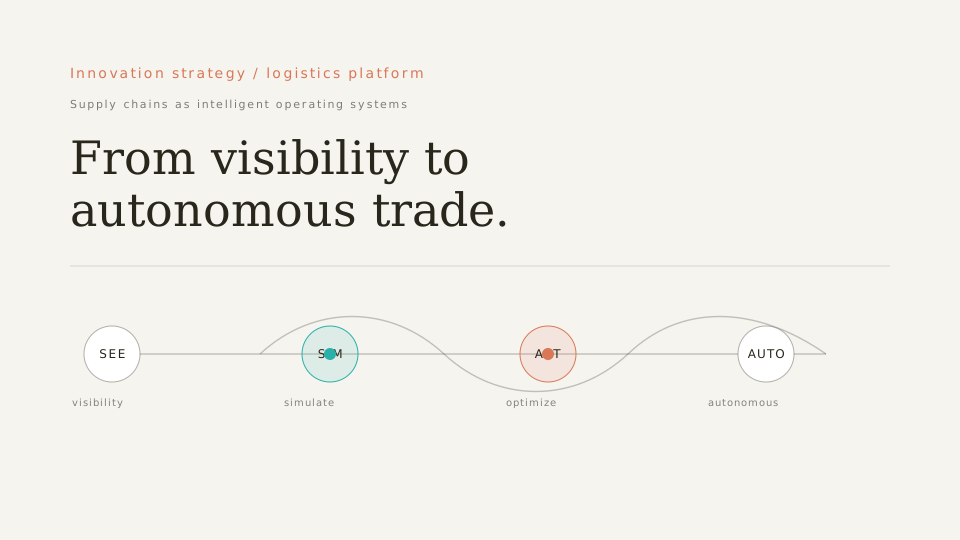
This project develops an innovation strategy for a logistics platform in a future where supply chains are shaped by climate pressure, regulatory fragmentation, data intelligence, and disruption risk. The work reframes the platform from a visibility tool into connective tissue for autonomous, trusted, and sustainable global trade.
Project overview
The innovation intent sets a 2036 ambition: zero disruption uncertainty, zero compliance friction, and fully autonomous sustainable supply chains.
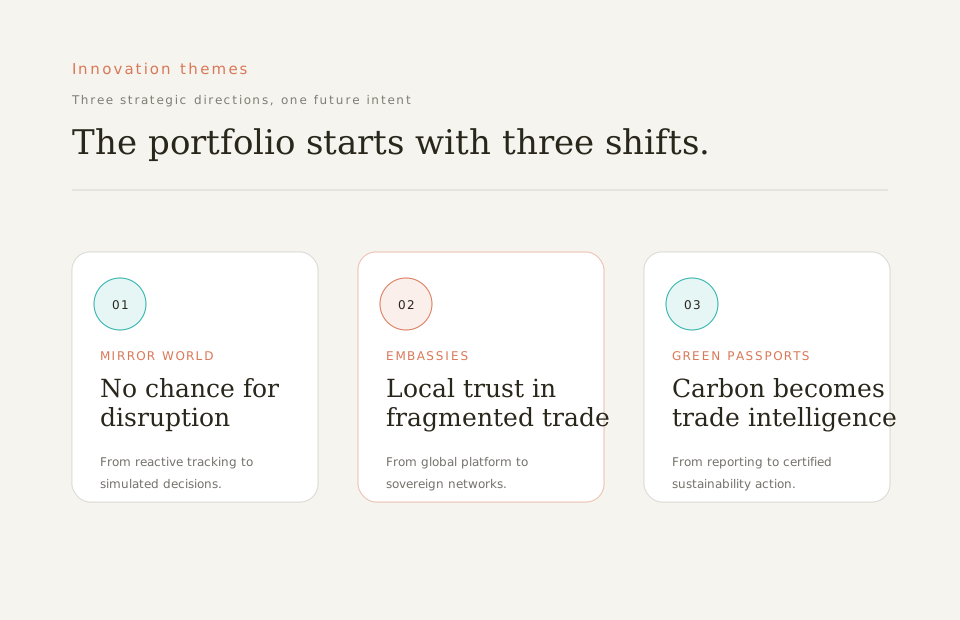
The portfolio is built from three strategic themes: a mirror world of logistics, local legal presence where platforms get blocked, and green passports for trade.
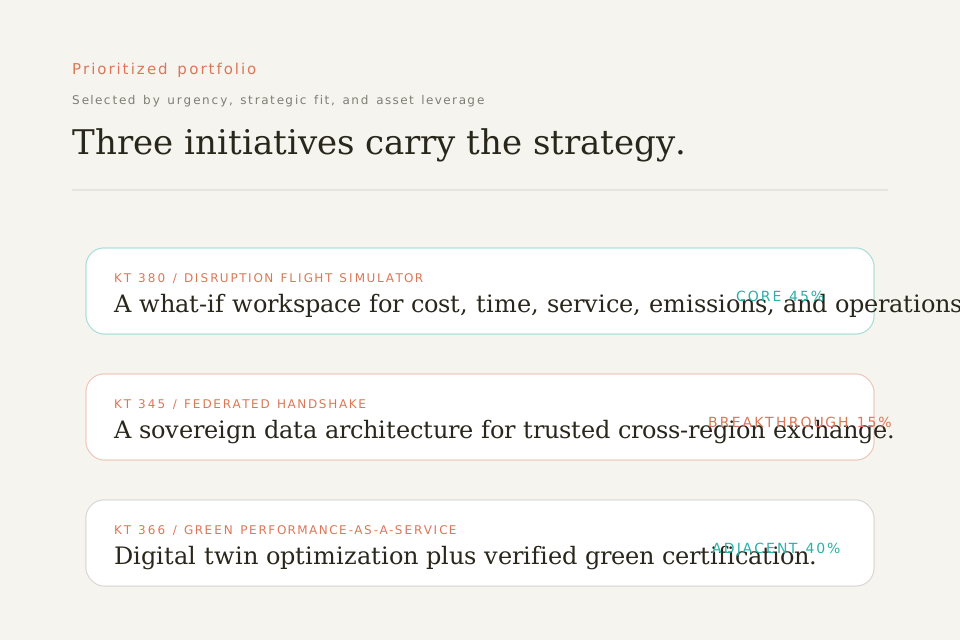
Three initiatives were prioritized through KT-style scoring: Disruption Flight Simulator, Federated Handshake, and Green Performance-as-a-Service.
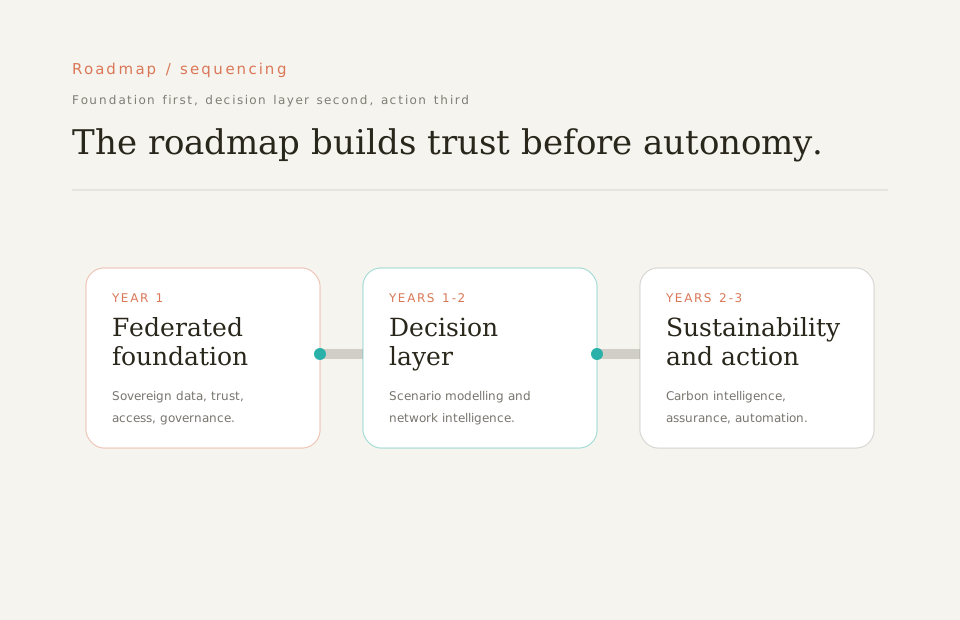
The roadmap sequences the work carefully: trusted data foundation first, decision intelligence second, sustainability and automation third.
Output: an innovation intent, three opportunity themes, prioritized portfolio, commercial sizing, and staged roadmap.
The strategy is not a list of product ideas. It is an integrated innovation system: federated data infrastructure makes cross-border trust possible, simulation turns visibility into decision intelligence, and green performance tools make sustainability measurable, optimizable, and commercially useful.
01 / Strategic Intent
The platform becomes the connective tissue of intelligent trade
The project imagines the platform in 2036 as the operating layer for a new era of supply chains: disruptions are anticipated before they happen, borders create less friction, and movement is optimized, trusted, and greener by default.
The mission is to rebuild global trade as a unified intelligent system despite fragmentation. This positions the platform beyond shipment visibility and toward decision advantage.
The unambiguous goal is deliberately sharp: zero disruption uncertainty, zero compliance friction, and fully autonomous sustainable supply chains.
02 / Innovation Themes
Three themes translate the future into strategic opportunity
Mirror World of Logistics turns the platform’s data position into a simulation environment where shippers can test disruptions, port closures, tariffs, capacity shocks, emissions, and operational tradeoffs before acting.
We Run Embassies, Not an Empire responds to regulatory fragmentation. It reframes expansion as a sovereign network problem: local legal presence, trusted credentials, and data exchange that can operate across jurisdictions.
Green Passports for Trade makes sustainability an active source of trade intelligence. Carbon stops being a reporting burden and becomes a certified performance layer that can affect cost, access, and advantage.
03 / Prioritized Portfolio
The selected initiatives combine urgency with strategic fit
In the assignment deck, the Disruption Flight Simulator scored highest at 380 because it is urgent, actionable, and directly builds on existing assets such as ETA intelligence, Disruption Navigator, and tariff simulation. The commercial sizing estimated a $15 million ARR opportunity against a $5 million build.
Federated Handshake scored 345 and creates the data trust infrastructure needed for global expansion. It addresses secure data flow across regions without exposing sensitive information, with assignment sizing estimating $285 million ARR and a $5.5-8 million build over 24 months.
Green Performance-as-a-Service scored 366 and connects digital twin simulation, optimization, and green certification. It helps customers not only measure emissions, but improve them, with assignment sizing estimating a $12 million revenue opportunity and a $5 million build.
04 / Business Shape
The portfolio balances core, adjacent, and breakthrough moves
The allocation uses a technology-pattern logic: 45 percent core, 45 percent adjacent, and 10 percent breakthrough.
Disruption Flight Simulator carries the core priority because it converts current visibility assets into a decision product customers can use immediately.
Green Performance-as-a-Service extends the platform into adjacent sustainability value, while Federated Handshake is the enabling breakthrough that lets the model operate across fragmented jurisdictions.
05 / Capability Shift
The strategy moves the platform from seeing to deciding
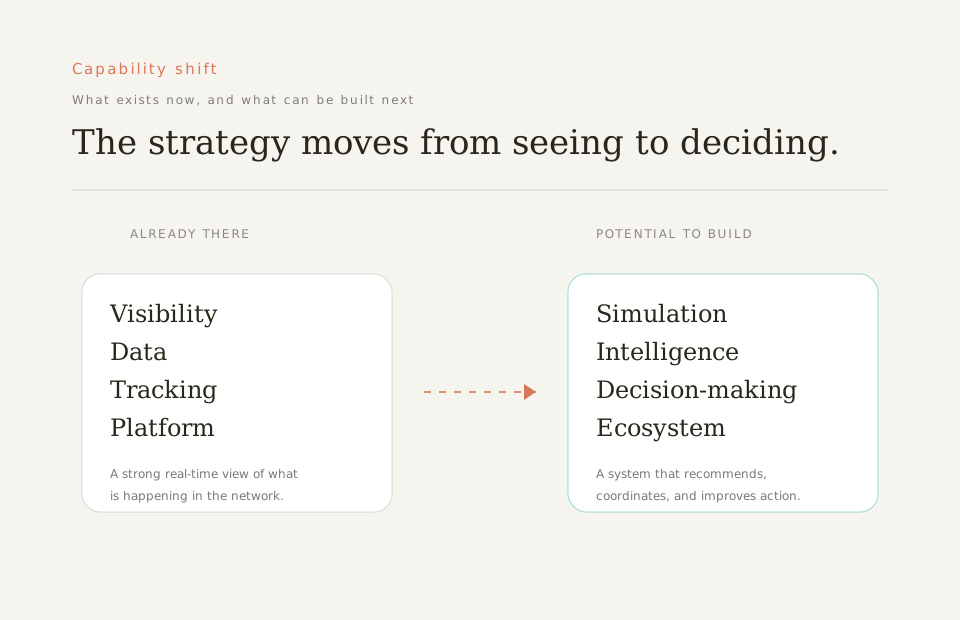
What already exists is strong: visibility, data, tracking, and a platform that connects many logistics actors.
What can be built is more strategic: simulation, intelligence, decision-making, and an ecosystem that coordinates shippers, carriers, regulators, and energy providers.
The key shift is from monitoring events after they happen to recommending and optimizing action before disruption becomes expensive.
06 / Roadmap
Sequencing matters because autonomy requires trust first
Phase one builds the federated foundation: sovereign data architecture, cryptographic trust, access control, and interoperability governance.
Phase two builds the decision layer: scenario modelling and network intelligence that turn visibility into a real decision tool.
Phase three adds sustainability and action: carbon intelligence, verification, assurance, and decision automation once the trusted base is ready.
The process
Scan
Read the future of supply chains
The work began with signals, STEEPV scanning, trends, futures wheels, and causal layered analysis to define the platform’s future context.
Intent
Set the innovation ambition
The team translated foresight into a clear innovation intent: autonomous, sustainable supply chains with less disruption uncertainty and less compliance friction.
Theme
Build strategic opportunity areas
Three themes turned the future context into innovation territory: mirror-world logistics, embassy-style market access, and green passports for trade.
Score
Prioritize initiatives
Ideas were scored through KT logic, then narrowed to the three initiatives with the strongest urgency, fit, and ability to build on existing platform assets.
Sequence
Turn portfolio into roadmap
The final strategy sequences the portfolio so foundational trust comes before decision simulation, and decision simulation comes before certified autonomous action.
Project visuals
Three themes translate future supply-chain pressure into strategic opportunity areas.The selected portfolio combines Disruption Flight Simulator, Federated Handshake, and Green Performance-as-a-Service.The core shift is from seeing what is happening to deciding what should happen next.The roadmap builds trust first, then decision intelligence, then sustainability and automated action.
Takeaways
Intent
The platform’s ambition becomes a clear future role: connective tissue for autonomous, trusted, sustainable trade.
Portfolio
The three initiatives work together instead of competing for attention: trust, simulation, and green performance reinforce one another.
Revenue
The work connects strategic imagination to commercial logic, including ARR estimates and implementation costs for the prioritized initiatives.
Roadmap
The proposed sequence reduces implementation risk by building infrastructure before advanced decision automation.