01 / SituationThe starting point is an ordinary social problem
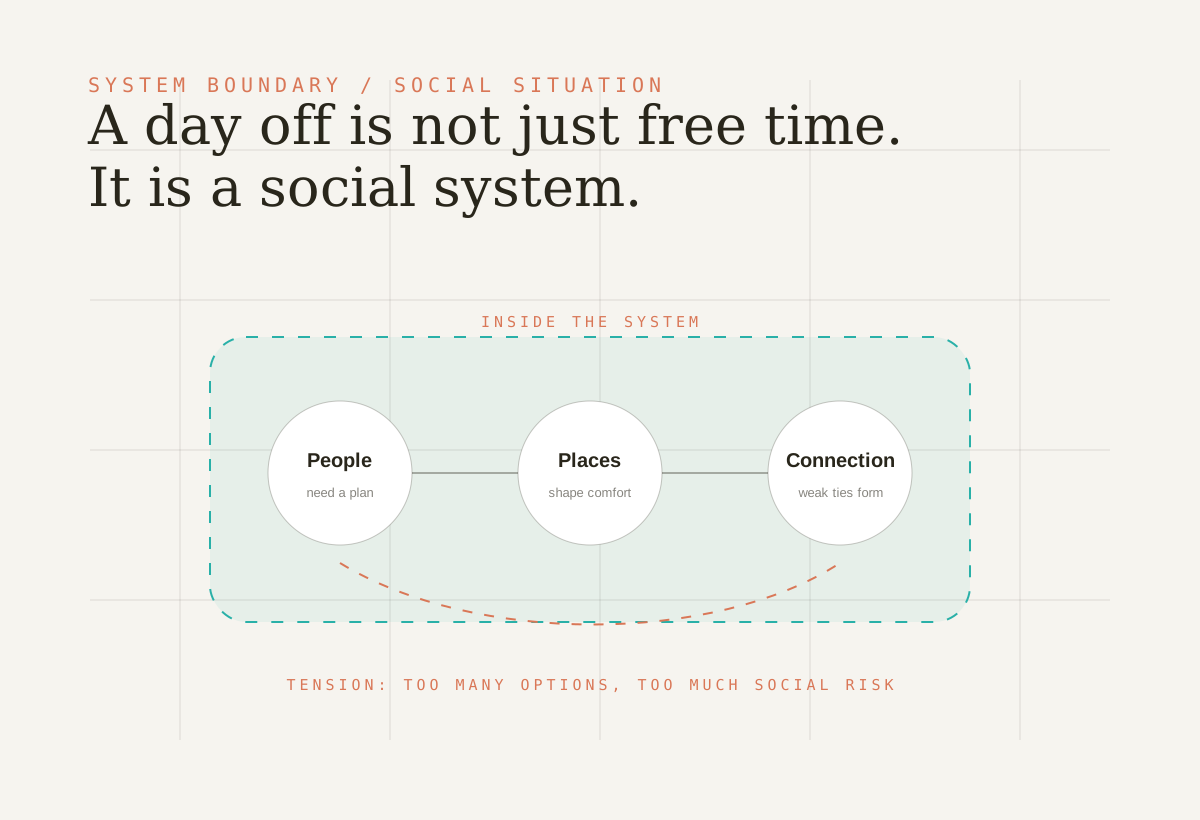
The project begins with a familiar situation: people want to enjoy a weekend or day off, but they do not know what to do, where to go, or which event or venue is worth choosing.
The situation also includes a social intention. These people are not only looking for entertainment; they are open to meeting new people, making acquaintances, expanding their network, or simply feeling less isolated in the city.
The purpose is personal fulfillment through experience: breaking routine, visiting places, doing different things, learning from life, and creating the conditions for connection.
02 / InsideThe system includes people, places, activities, and meaning
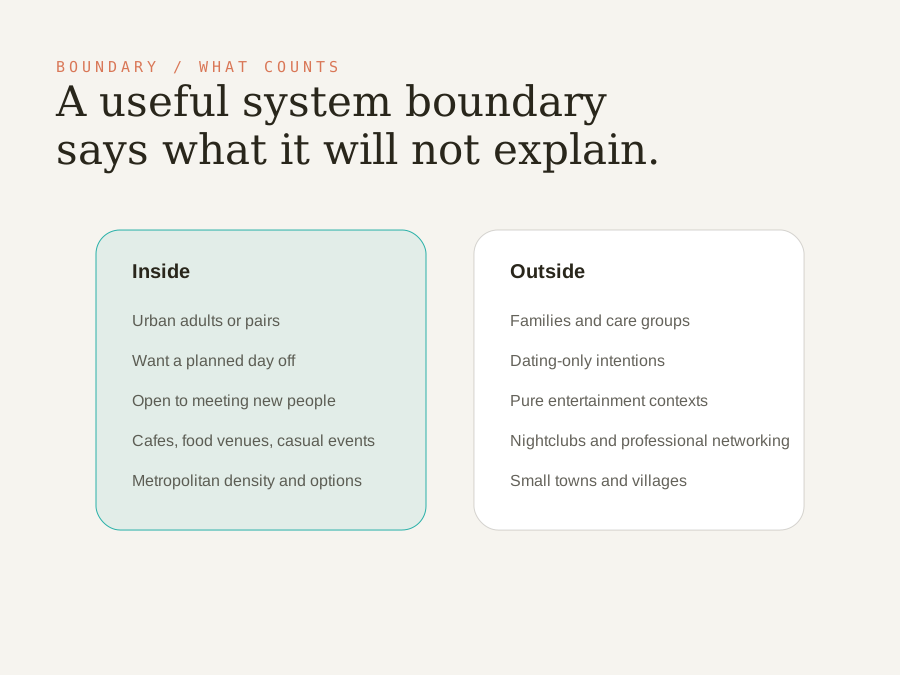
Inside the boundary are urban individuals or pairs who want a clear plan for their day off and do not want to spend their energy sorting through endless online recommendations and reviews.
The relevant places are everyday social environments: cafes, casual events, food venues, and urban spaces where comfort, belonging, excitement, and shared attention can emerge.
The system is not only made of actors. It includes points of interaction: the space, the experience it enables, the activities that happen there, and the meanings people attach to those encounters.
03 / OutsideThe exclusions are part of the design
Families are excluded because they involve a different care structure, decision logic, and set of needs. The system is not trying to explain family leisure planning.
People looking primarily for romantic partners are also outside the boundary. Dating apps and dating contexts already serve a different intent, while loneliness and connection are broader than romance alone.
Nightclubs, lounges, professional networking, pure entertainment, small towns, and villages are excluded because they change the goals, social norms, density, infrastructure, and interaction dynamics.
04 / TensionsThe key barrier is not only options. It is social entry.
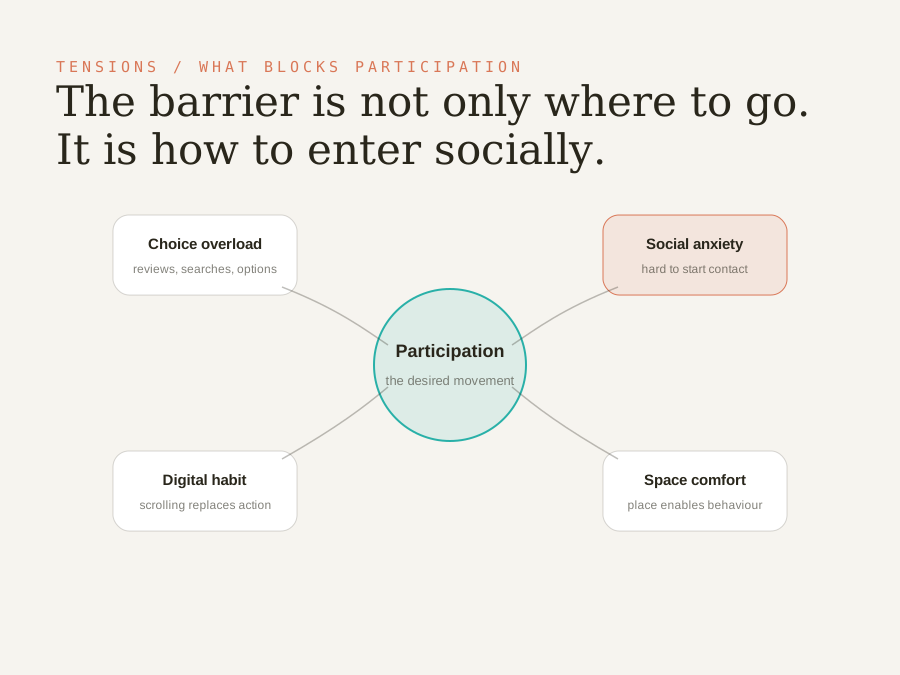
One tension is choice overload: people face too many recommendations, online searches, reviews, and possible venues, which can make planning feel like work.
Another tension is social hesitation. Even when people want to connect, initiating conversation with strangers can feel uncomfortable, especially when anxiety limits participation.
A third tension is habit. Social media can make real-time, in-person interaction less likely by offering an easier default that keeps people from entering shared spaces.
05 / GeographyThe system belongs mainly to urban and metropolitan contexts
Urban cities and metropolitan areas matter because density creates frequent opportunities to meet, choose between venues, and encounter unfamiliar people in shared spaces.
Small towns and villages are outside the boundary because their social infrastructure, pace, and landscape are more oriented toward familiarity, quietness, and dispersed interaction.
This geographic judgment is not about value. It keeps the system coherent by focusing on the conditions where spontaneous social participation is more likely to be designed around.
06 / Boundary JudgementThe boundary protects the analysis from becoming too broad
The case makes its boundary logic explicit: include the people, places, and interactions that shape the day-off social situation; exclude adjacent systems that follow different rules.
A critique might argue that lonely people need romantic partners, but the project separates loneliness from dating. The gap is not only about romance; it is about broader connection and participation.
The same logic applies to families, nightlife, professional networking, and small towns. Each could be its own system, but adding them here would blur the intervention logic.
07 / SensemakingSome parts can be organized. Human dynamics need interpretation.
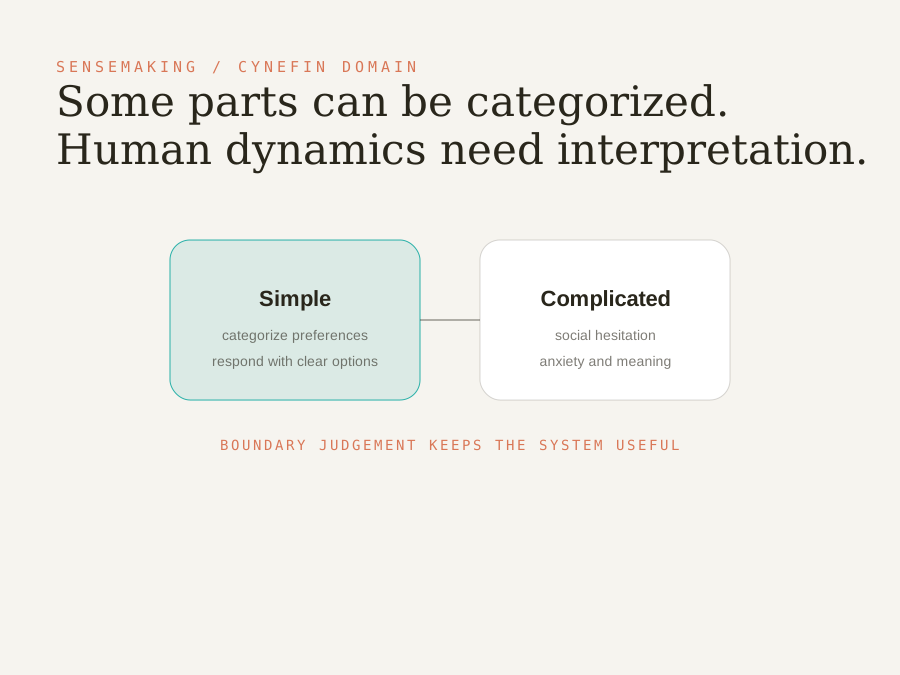
Some needs can be categorized: preferences, places, activities, and basic matching can be organized into clearer options.
At the same time, human behaviour, anxiety, meaning, and social comfort require deeper interpretation.
The design implication is that the first layer can help people categorize and choose, while the deeper layer must respect the social dynamics that make connection feel safe or difficult.
08 / What It ProvesGood systems work starts by deciding what not to solve
As an Understanding Systems assignment, the work demonstrates bounding before solutioning: the first design move is deciding which slice of social life can be responsibly examined.
The project shows that bounding is not a technical formality. It is a strategic design act that defines which actors, spaces, tensions, and contexts matter for the question at hand.
By narrowing the system, the work makes a fuzzy social challenge easier to read: people need help moving from unplanned time and choice overload into comfortable, low-pressure participation.
The proof is the boundary itself: a focused system map that can guide future service, platform, or experience design without pretending to solve all urban loneliness.