01 / ContextThe work started with community stability and spatial inequity
The original frame focused on Ward 5, York South-Weston, where many neighbourhoods are classified as Neighbourhood Improvement Areas. In places like Mount Dennis, community organizations are essential social infrastructure, but many rely on leased space rather than ownership.
Because they depend on private landlords, limited public programs, or discounted rents, these organizations remain exposed to redevelopment, rising commercial rents, and the discretion of property owners.
When a nonprofit is displaced, the loss is not only organizational. Residents lose access to food support, skills training, childcare, social connection, and trusted services close to home.
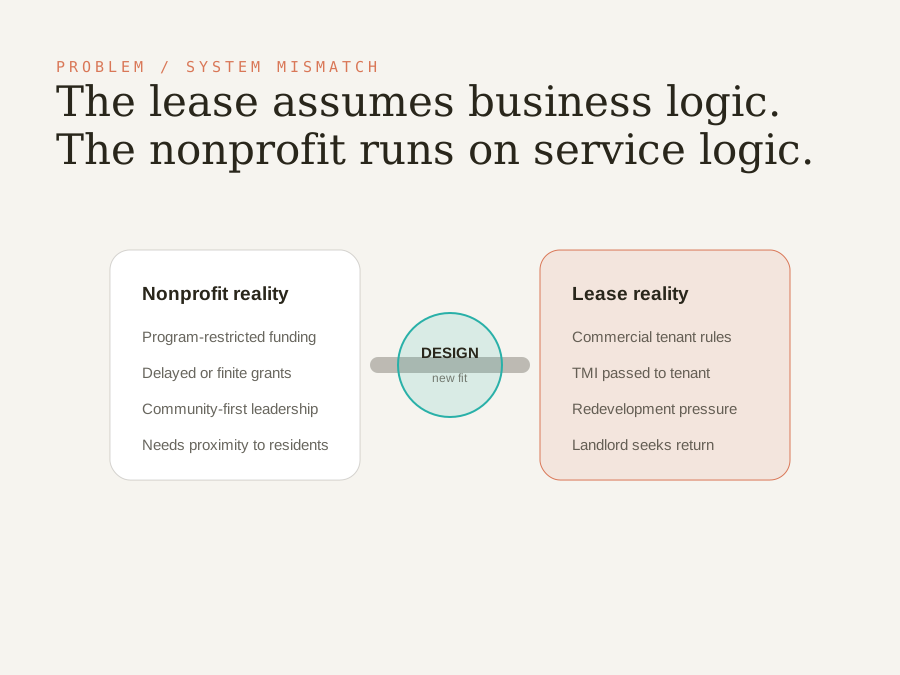
02 / ProblemNonprofits are treated as commercial tenants, but they do not operate like commercial businesses
Toronto’s commercial real estate market is shaped by private ownership, REITs, institutional investors, and asset appreciation. Access to space is largely determined by capital.
Commercial leases often transfer property taxes, maintenance, and insurance costs onto tenants through TMI. For businesses, this may be part of operations; for nonprofits with restricted or delayed grants, it can destabilize the entire organization.
The problem statement became clear: unaffiliated nonprofits face barriers to obtaining and retaining affordable commercial leases for their operations.
03 / Leverage PointThe intervention sits at the commercial leasing model
The team identified access to space as the territory of intervention, with commercial leasing and ownership models as the main leverage points.
Ownership was not treated as a scalable answer for most organizations because nonprofits often face limited access to loans, insufficient capital, and financing barriers.
The design challenge became how to make leasing itself more stable: a model that protects nonprofits without ignoring the financial realities of landlords and government.
04 / JourneyThe tenancy journey breaks down at entry, operation, and exit
Entry is constrained because public programs such as Community Space Tenancy can offer below-market rents, but demand exceeds supply and waitlists limit access.
Operation is fragile because even discounted leases still require insurance, taxes, maintenance, and other costs that compete with program delivery.
Exit is the existential risk. When a lease expires, a property is sold, or redevelopment becomes attractive, years of community trust and service capacity can be displaced quickly.
05 / Why Existing Support Is Not EnoughDiscounted rent and ownership do not solve the core system failure
Existing supports matter, but they do not reach enough organizations. City-owned community space is limited, geographically uneven, and unable to absorb the scale of nonprofit need.
Ownership is also not a realistic answer for many unaffiliated nonprofits because they face limited access to loans, insufficient capital, and financing barriers.
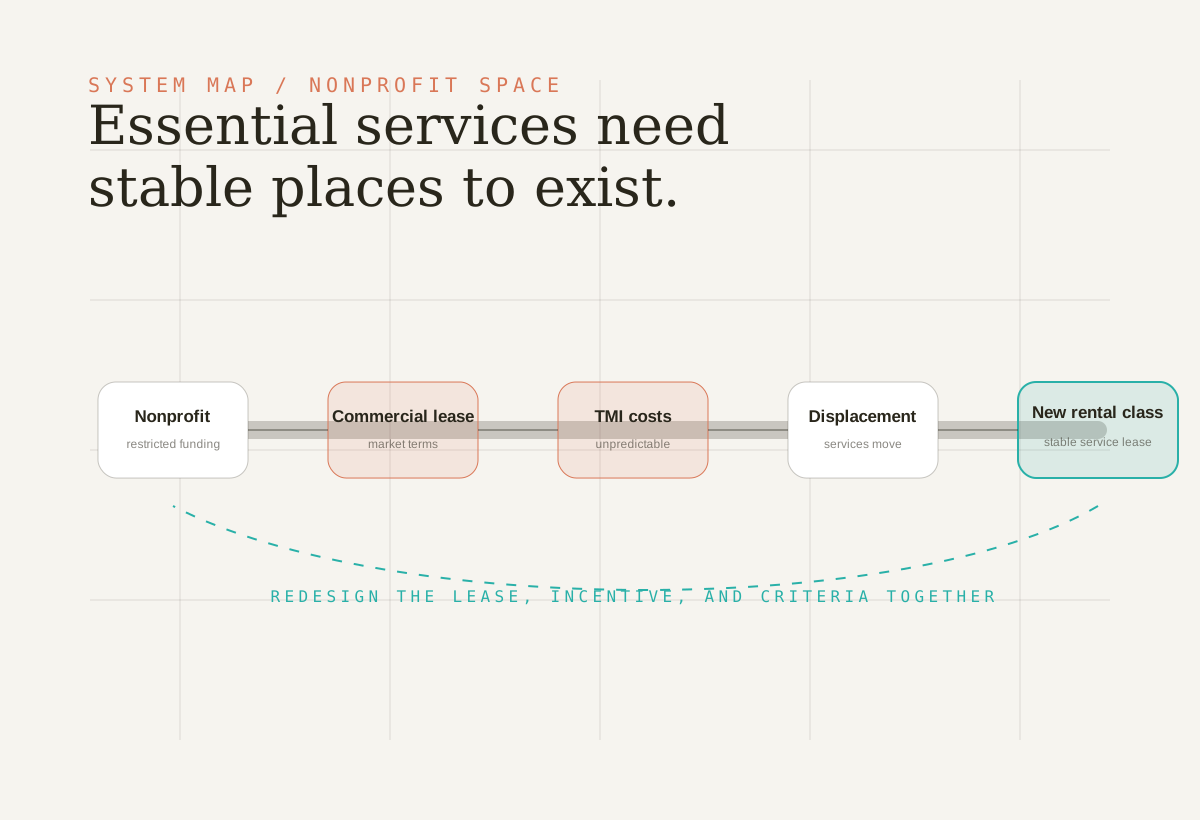
That is why the project moves toward a nonprofit-specific leasing model: it targets the relationship nonprofits are already trapped inside rather than asking every organization to escape the market alone.
06 / SolutionThe solution is a new rental class for community-serving nonprofits
The proposed Community Service Lease Designation creates a stable rental class for unaffiliated nonprofits, starting in Neighbourhood Improvement Areas.
The model combines a standardized nonprofit lease, capped or offset operating costs, clearer renewal terms, eligibility criteria, and landlord incentives that reduce the risk of renting to nonprofits.
It also adds capacity support: nonprofits that do not yet meet readiness criteria would receive governance and lease-literacy support rather than being rejected outright.
07 / PartnersThe solution only works if the right actors share responsibility
The Ministry of Municipal Affairs and Housing owns the innovation by developing the rental class, lease structure, and criteria.
Treasury Board and the CRA help shape spending discipline, tax implications, and incentive feasibility. Toronto Strong Neighbourhoods Strategy and city councillors bring neighbourhood insight and community priorities.
Unaffiliated nonprofits and commercial landlords are both partners and customers: they provide the lived reality needed to make the criteria usable rather than symbolic.
08 / ImplementationThe work becomes a staged policy and service design process
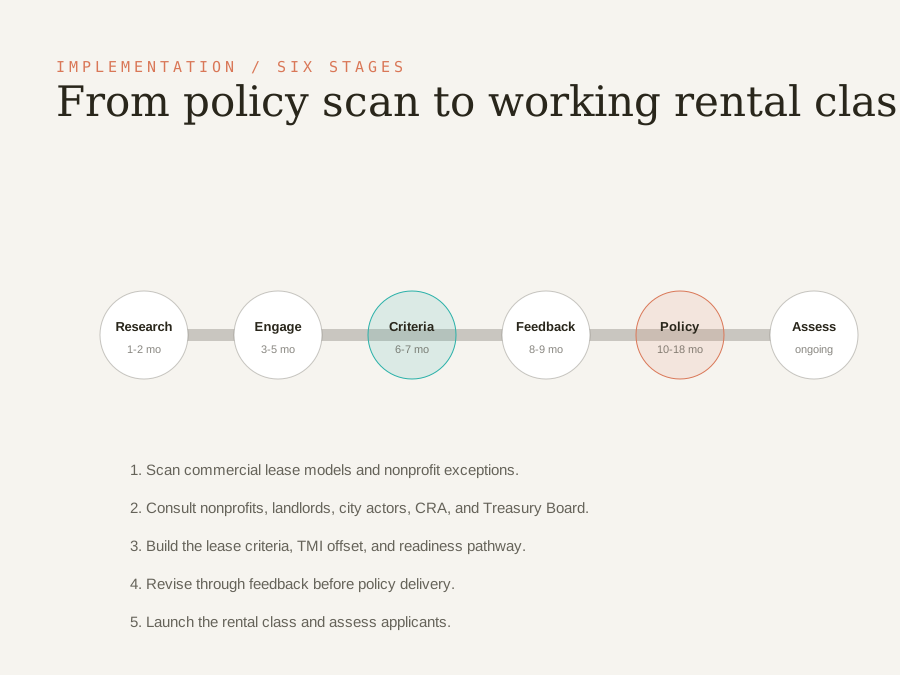
The proposed implementation moves through environmental research, stakeholder engagement, plan and criteria development, feedback loops, policy delivery, and assessment.
The timeline runs from a policy scan and lease research in months 1-2, to engagement in months 3-5, plan and criteria design in months 6-7, feedback in months 8-9, and policy delivery through months 10-18.
This sequence treats policy as a designed service: research the system, co-design with affected actors, test viability, then deliver the new class with an assessment pathway.
09 / ModelThe TMI offset turns landlord incentive into nonprofit stability
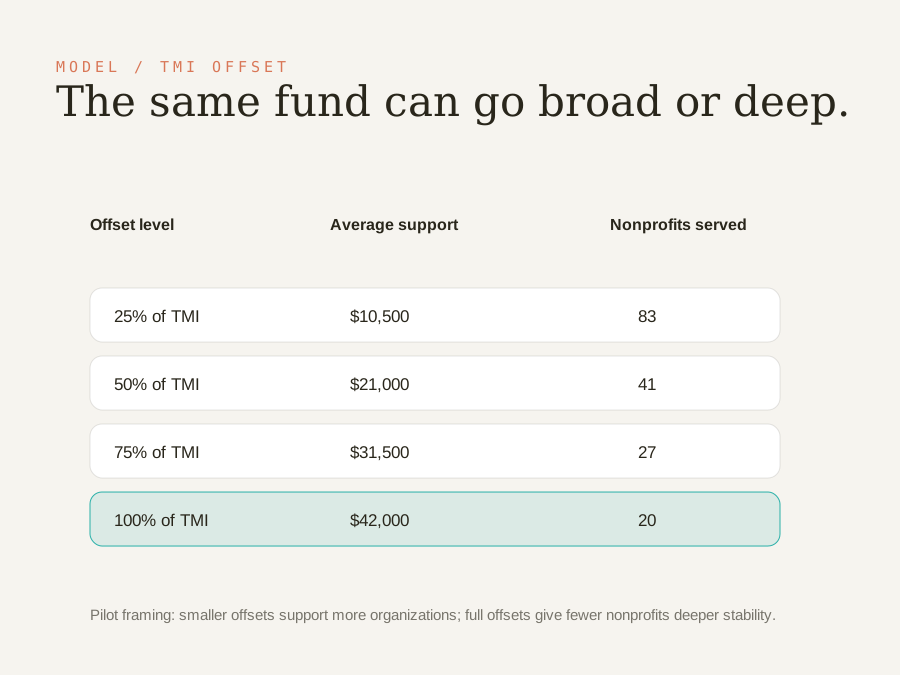
The solution models different TMI offset levels. A 25% offset at roughly $10,500 could support 83 nonprofits and landlords; a 100% offset at roughly $42,000 could support 20.
This creates a strategic choice between breadth and depth: support more organizations with partial relief, or provide deeper stability to fewer organizations.
The broader financial logic estimates a $1.05M startup cost, a $1.15M annual funded inflow through public cost-sharing and avoided downstream costs, and a net-positive program after roughly 18-24 months.
10 / Success MeasuresThe solution needs proof that stability is actually improving
The report proposes clear signals of improvement: fewer nonprofits losing or closing locations due to cost, more funding streams that include space or facility costs, and more nonprofit leaders trained in lease and contract management.
Quantitatively, the measures include a 15% decrease in location-loss risk, 10% growth in grants that cover space costs, and 75% of nonprofit leaders completing lease or contract training.
The work also sets a community-to-lease investment ratio: more than 85% of resources should support community value, while less than 15% should be absorbed by lease burden.
11 / What It ProvesStability is a design condition, not just a funding problem
The case shows that nonprofit displacement is not caused by one bad lease or one bad landlord. It is produced by a mismatch between service-oriented organizations and market-oriented real estate rules.
The strongest solution is therefore not a single grant. It is a redesigned relationship between lease terms, public incentives, eligibility, landlord participation, and nonprofit capacity.
That is the strategic lesson: if communities depend on nonprofits, then space for nonprofits has to be treated as public-serving infrastructure.